To use the Poké Radar in Pokémon X and Y, stand in tall grass or a flower bed on foot and use it from the Key Items pocket. Up to five patches shake. Walk into one that shakes hard, then knock out or catch the Pokémon inside to start a chain. You get the Radar after entering the Hall of Fame, from a scientist on 2F of Professor Sycamore’s Lab in Lumiose City. Move with the +Control Pad, never the Circle Pad, and never step into a patch that only shakes faintly. From a chain of 40, each hard-shaking patch has a 1 in 100 chance to sparkle, and a sparkling patch always holds a Shiny. Pokémon Y works the same way.
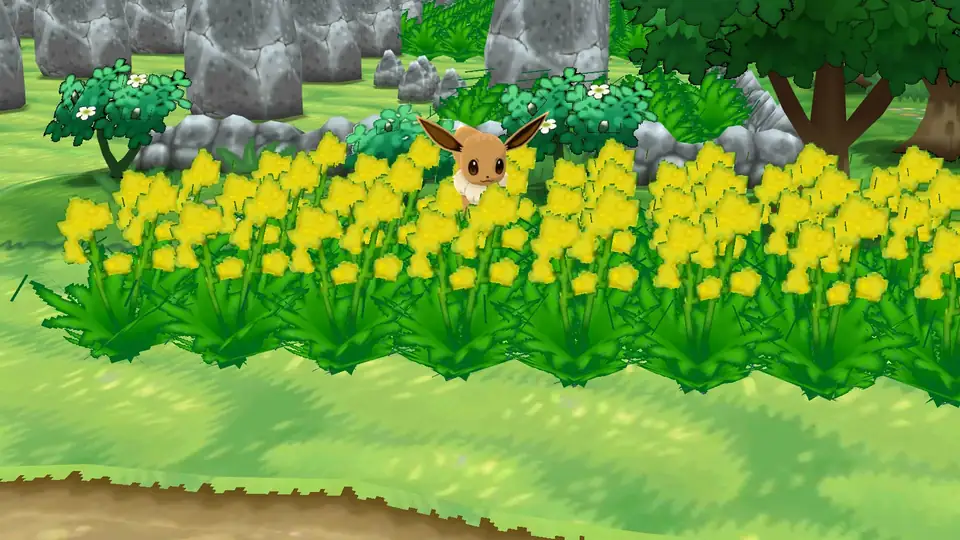
Poké Radar in Pokémon X and Y at a glance
| Question | Answer |
|---|---|
| Where do I get it? | From the scientist on the right of 2F in Professor Sycamore’s Lab, Lumiose City |
| When? | After you enter the Hall of Fame |
| Where does it work? | Tall grass and flower beds, on foot. Not in long grass, not in the Friend Safari |
| Recharge | Walk. A full charge takes 50 steps |
| Which patch should I step in? | One that shakes violently, ideally 4 tiles away. Weakly shaking patches are always empty |
| Best Shiny odds | 1 in 100 per violently shaking patch, from a chain of 40 on |
| Does Pokémon Y differ? | No. Same item, same scientist, same rules. Only some wild Pokémon change |
Why your Poké Radar won’t work
If the Radar refuses to work or a chain dies early, it’s usually one of these:
| What happens | Cause | Fix |
|---|---|---|
| The “There’s a time and place for everything” message | You’re not in tall grass or flowers, or you’re on Roller Skates or the Bicycle | Stop skating, get off the bike, and step into tall grass or a flower bed |
| A battery-level message telling you to walk | The battery isn’t full | Walk until it’s charged (50 steps from empty), then use it again |
| Few patches shake, or none | You’re near the edge of the grass, so the rings land on dirt or path | Move to the middle of a large field (see the ring map below) |
| “Huh? But there don’t seem to be any Pokémon around...” | You walked into a weakly shaking patch | That chain is over. Skip faint shakes next time |
 The Circle Pad puts your Roller Skates on. The Radar can’t be used on skates, so one nudge of the Circle Pad is enough to make it stop working. Steer with the +Control Pad from the moment you use the Radar until the chain ends. Skating or riding the
 Bicycle during a chain resets it, and the Radar has to recharge before you can use it again.
Long grass, the darker and taller grass on some routes, doesn’t count. Neither does the Friend Safari, even though its grass looks normal. If the message shows up, check what you’re standing on and whether you’re on wheels.
Where to get the Poké Radar after the Hall of Fame

 Go to Professor Sycamore’s Lab in Lumiose City, take the elevator to 2F, and talk to the scientist on the right side of the room. Once you’ve entered the Hall of Fame, he gives you the Poké Radar. It goes into your Key Items pocket, and you can’t buy or sell it.
In Diamond, Pearl and Platinum the Radar came with the National Pokédex. In X and Y the Hall of Fame is what opens it up, so don’t go looking for a Sinnoh requirement.
The daily research gifts
Once a day, the same scientist picks a species for you to study. Chain that species with the Radar and go back to him. He gives items based on your longest chain of that species that day. You can collect more than one item in a single visit, but each item only once per day.
| Longest chain of the day’s species | Gift |
|---|---|
| 1 or more |  Ultra Ball |
| 11 or more |  PP Up |
| 21 or more |  PP Max |
| 31 or more |  Rare Candy |
A free PP Max and Rare Candy each day is a nice bonus. It’s worth doing when his species lives somewhere you were heading anyway.
How to use the Poké Radar the first time
- Register it. Open the Bag, go to Key Items and register the Poké Radar to the Y Button. That makes resets quick. It doesn’t stop the Roller Skates, which come on from the Circle Pad, so keep to the +Control Pad.
- Pick a big field. Walk to the middle of a wide stretch of tall grass or flowers, at least four tiles in from every edge.
- Use a Repel. A
 Super Repel (200 steps) or
 Max Repel (250 steps) stops random battles, which can throw a different species at you mid-chain. Radar patches still start a battle with a Repel on. A Repel only blocks wild Pokémon below your lead’s level, so lead with something higher than anything on the route.
- Use the Radar. A tune starts and up to five patches shake for a moment: one per ring, plus maybe a faint decoy. Turn the volume up, because the rustle tells you how hard a patch is shaking.
- Walk into a violently shaking patch. Use the +Control Pad. The battle starts as soon as you step in.
- Knock out or catch the Pokémon. Either keeps the chain going. Running away ends it. After the battle, new patches shake on their own and the chain goes up by one.
- Reset when needed. If every patch looks bad, walk back and forth until the battery is full and use the Radar again. Using it in the middle of a chain doesn’t break the chain.
Saving doesn’t protect a chain. Turning the game off ends it, even right after a save.
The four kinds of shaking patch
Each time the Radar goes off, the game tries to place one patch in each of four square rings around you. Ring 1 is the eight tiles touching you, and ring 4 is the outer edge of a 9 × 9 square. Then it may add one faint decoy somewhere in rings 1–3, unless that spot is already taken. Each patch is one of these:
| Patch | What you see and hear | What’s inside | Step in? |
|---|---|---|---|
| Violently shaking | Shakes hard, side to side and up and down, with a loud rustle | The species you’re chaining. If it doesn’t sparkle, that Pokémon won’t be Shiny. Some violent-looking patches are disguised regular ones (see below) | Yes, ideally on ring 4 |
| Shaking | Sways side to side with a light rustle | A random Pokémon from the area’s normal table. The wrong species ends the chain. Some are disguised violent patches | Only if nothing better shook |
| Weakly shaking | A faint sway and a very quiet rustle | Nothing. You get “Huh? But there don’t seem to be any Pokémon around...” and the chain ends | Never |
| Sparkling | A violent shake plus a sparkle and the Shiny sound | A Shiny of the species you’re chaining, every time | Yes |
A hard shake can still lie. One in five violently shaking patches looks like a regular one, and one in ten regular patches looks violent. The weak decoy never changes its look. You can’t tell a disguise apart by eye, and that’s why the outer ring matters. A patch on ring 4 starts out violent far more often than one on ring 1, so a hard shake out there is the safest bet.
X and Y have no Radar-only Pokémon. Every patch draws from the same table you’d get walking through that grass, which is a change from Diamond and Pearl.
How to chain to 40 without breaking it
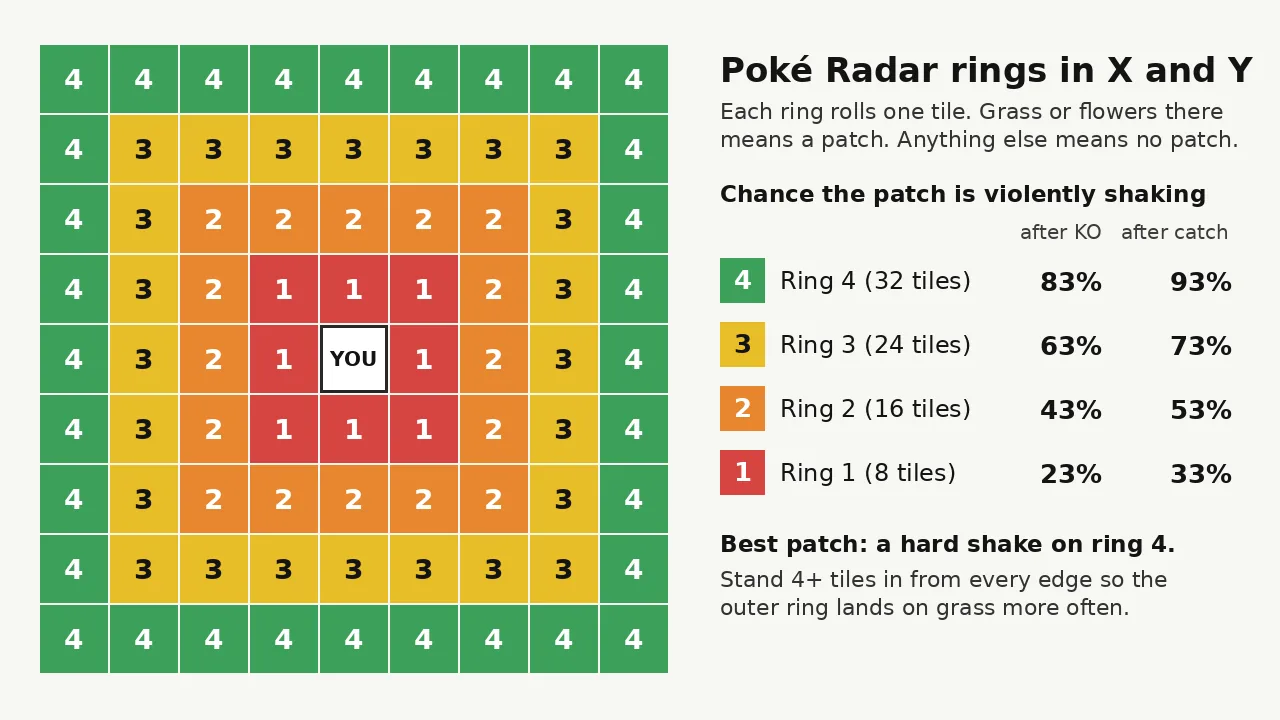
Every ring that gets a patch has a set chance to make it violently shaking. The chance depends on how your last battle ended:
| Ring | Distance | After a knockout | After a catch |
|---|---|---|---|
| 1 | Touching you | 23% | 33% |
| 2 | 2 tiles away | 43% | 53% |
| 3 | 3 tiles away | 63% | 73% |
| 4 | 4 tiles away | 83% | 93% |
A catch adds 10 points to every ring, and the bonus lasts until your next encounter, resets included. If you have Poké Balls to spare, catching is the safer way to chain.
For each ring, the game picks a side of the square and then a tile on that side. If that tile has no grass or flowers, the ring makes no patch. If no ring makes a patch, the chain ends right there, with no warning. When a chain dies like that for no clear reason, you were probably standing near an edge. In a thin flower strip most of ring 4 is bare ground, so the best patch hardly ever appears. Pick a wide field.
The routine that keeps a chain alive
- After each battle, look for a violently shaking patch on ring 4, the outer edge.
- If there isn’t one, take a violent patch on ring 3. Skip rings 1 and 2 unless you caught the last Pokémon and feel lucky.
- If nothing good shook, don’t gamble. Walk back and forth until the battery is full and use the Radar again.
- The new patches form around wherever the battle left you. Step back toward the middle of the field before you reset.
- Watch your PP. Leaving to heal ends the chain, so bring Leppa Berries or a Pokémon with a high-PP move to spare.
Everything that breaks a chain
- Running from a battle, or meeting a different species
- Stepping into a weakly shaking patch
- A Horde Encounter, Sweet Scent or Honey
- A Trainer battle or a story event
- Using a field move, the Dowsing Machine or any fishing rod
- Picking up an item
- Getting on the Bicycle or Roller Skates, including by touching the Circle Pad
- Leaving the area, or walking so far that every shaking patch is off the screen
- An Egg hatching in your party. Leave Eggs in the PC
- Turning the game off or reloading, even after saving
One X and Y rule helps you here. If you run into the species you’re chaining in ordinary, non-shaking grass, the chain can still continue.
Shiny odds, chain 40 and IVs
Only a violently shaking patch can sparkle. Its chance starts at 1 in 8,100 and the second number drops by 200 with every link, down to 1 in 100 at a chain of 40. It doesn’t improve after that. The first Radar use, at chain 0, can’t sparkle at all.
| Chain | Each violent patch | Per reset, all four rings (after KO) | Per reset (after catch) |
|---|---|---|---|
| 0 | Can’t sparkle | 0% | 0% |
| 1 | 1 in 7,900 | 0.027% | 0.032% |
| 10 | 1 in 6,100 | 0.035% | 0.041% |
| 17 | 1 in 4,700 | 0.045% | 0.054% |
| 20 | 1 in 4,100 | 0.052% | 0.061% |
| 30 | 1 in 2,100 | 0.10% | 0.12% |
| 35 | 1 in 1,100 | 0.19% | 0.23% |
| 39 | 1 in 300 | 0.71% | 0.84% |
| 40 and up | 1 in 100 | 2.10% | 2.50% |
The “per reset” columns are the chance of at least one sparkling patch when all four rings land on grass, so they’re the best case in a big field. A normal wild Pokémon in X and Y is Shiny 1 in 4,096. The chain only beats that from 21 on, and the big jump comes in the last few links. Once you hit 40, stop taking risks: recharge, reset, and only enter a sparkling patch.
Should you stop at chain 17?
No. Stopping at 17 and resetting is advice from other Radar games. In X and Y, a chain of 17 still gives each violent patch only 1 in 4,700. Keep going to 40.
The upbeat music and your birthday
Each time a battle continues the chain, there’s a 2% chance the music switches from “A Poké Radar Hit!” to the faster “Poké Radar Chain!”. On your birthday the chance is 4%. While the faster track plays, every violent patch sparkles at 1 in 100, whatever your chain length. Each Radar use or encounter has a 50% chance to switch the music back.
Catching the Shiny vs. knocking it out
Catching the Shiny from a sparkling patch doesn’t end the chain, and your count stays. The sparkle chance drops back to 1 in 8,100, though. Knocking it out, or resetting past it, keeps the 1 in 100 rate. If the upbeat music was playing when you met the Shiny, catching it doesn’t reset the rate. To get more than one Shiny out of a single chain of 40, catch during the upbeat track or climb back up.
Guaranteed perfect IVs
Long chains also guarantee IVs of 31. At a chain of 21 to 40, every Pokémon the Radar produces has at least one stat at 31. From 41 to 60 it’s at least two, and from 61 on it’s at least three. Catching a Shiny resets the sparkle chance but not the IV bonus.
 The Shiny Charm doesn’t help sparkling patches. With or without it, a violent patch tops out at 1 in 100 at chain 40. The Charm only affects regular shaking patches, which use the normal Shiny roll (about 1 in 4,096, or about 1 in 1,365 with the Charm). The table above stays the same.
Best places to chain in Kalos
Look for three things: a wide field, a lead that outlevels the route so your Repel works, and a target that shows up often. You have to find the first one the normal way, so these are the odds of meeting it on the first encounter:
| Spot | Good targets (X / Y) | Levels | Notes |
|---|---|---|---|
| Route 10, yellow flowers | Eevee 20%, Snubbull 30%, Houndour (X) / Electrike (Y) 20% | 19–21 | The best Eevee chain in Kalos. The beds are thin, so stand where flowers surround you |
| Route 10, tall grass among the standing stones | Golett 30%, Sigilyph 20%, Hawlucha 20% | 19–21 | A big field and an easy place to practice. Eevee is only 5% here |
| Route 5, purple flowers | Skiddo 30%, Pancham 20% | 8–10 | A low-level route for practice runs |
| Route 7, flowers | Flabébé 35% (yellow or blue, by flower bed, plus orange and white), Smeargle 10% | 12–14 | The Day Care is on this route |
| Pokémon Village, yellow flowers | Ditto 20%, Zoroark 10% | 48–50 | A high-IV Ditto is a strong breeding partner. Bring a Lv. 51+ lead for the Repel |
For a full Route 10 Eevee plan, including the right Repel lead, see where to find Eevee in Pokémon X. To find these routes, open the 3D Kalos map. Then evolve your chained Eevee into Espeon or Umbreon.
Poké Radar vs. other shiny methods in X and Y
| Method | Best for | Drawback |
|---|---|---|
| Poké Radar at chain 40 | Grass and flower Pokémon, with perfect IVs on top | Chains break easily, and it only works in grass and flowers |
| Friend Safari | Hidden Abilities and a better base Shiny rate | The Radar doesn’t work there, and you need 3DS friends |
| Chain fishing | Water Pokémon | Any missed bite ends the streak |
| Masuda Method | Any species you can breed | Needs a parent from a different-language game, and lots of Eggs |
The Radar has no Hidden Ability patch in X and Y. For Hidden Abilities, the Friend Safari is the main source. And the Shiny Stone has nothing to do with Shiny Pokémon. It’s an evolution stone.
Coming from Diamond, Pearl or Brilliant Diamond?
- How you get it: after the Hall of Fame, on Sycamore Lab 2F. Not with the National Pokédex.
- Exclusive species: none. Every patch uses the area’s normal table.
- Patches: X and Y add a weakly shaking decoy that always ends the chain.
- Odds: 1 in 8,100 at the start, 1 in 100 from 40. No Hidden Ability patch.
Poké Radar FAQ
How do you get the Poké Radar in X and Y?
Enter the Hall of Fame, then talk to the scientist on the right of 2F in Professor Sycamore’s Lab in Lumiose City.
Why does it say there’s a time and place for everything?
You aren’t standing in tall grass or flowers, or you’re on Roller Skates or the Bicycle. The Circle Pad puts the skates on, so walk with the +Control Pad.
How many steps does it take to charge?
50 steps from empty. The game shows the battery level and tells you to walk.
Should I knock out or catch to keep the chain?
Either works. Catching raises the violent-patch chance on every ring by 10 points until your next encounter.
Does the Shiny Charm help the Poké Radar?
Only in regular shaking patches. Sparkling patches depend on the chain alone, and top out at 1 in 100 with or without the Charm.
Can the Poké Radar find Hidden Ability Pokémon in X and Y?
There’s no Hidden Ability patch in X and Y. Use the Friend Safari for Hidden Abilities.
Does the chain-17 method work in X and Y?
No. In X and Y, a chain of 17 is still only 1 in 4,700 per violent patch. Keep chaining to 40.